
Capture Your Best Ideas

Last updated: November 2026.
The most reliable way to capture an idea is to record it within seconds, using whatever tool is already in your hand: a pocket notebook, a voice recorder or the voice memo app on your phone. Working memory is small and easily bumped by the next thing you think about, so a thought you don’t write down often simply disappears.
Have you noticed that your best ideas show up in the shower or while you do some mundane task on autopilot? And that if you don’t note them right away, you can’t get them back, no matter how hard you try?
We use three methods that work well for catching those ideas before they’re lost.
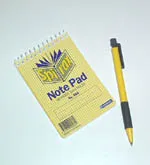
- Write It Down
Buy a pack of small notebooks, either the 3×5 tear-off pads that come in a pack of 5 or 6, or small spiral-bound notebooks. Keep them handy.
Whenever a great idea pops into your head, stop what you’re doing as quickly as possible, grab the notebook and jot it down. Be sure to write enough detail to really jog your memory. How many times have you come across a note with some cryptic phrase scribbled in your handwriting, and you have no clue as to what it means? - Use A Digital Recorder
There are all kinds of digital recorders on the market that are perfect for capturing thoughts and ideas. If you don’t own one already, take some time to research what’s available to find the right model for you. Carry it with you or keep it nearby. Dictating can be far more efficient than writing notes, as long as you don’t record material and then forget about it because you don’t have a hard copy to jog your memory. - Record On Your Mobile Phone
Download a recorder app for your mobile phone. This will be the easiest method for most people. Pew Research Center’s 2025 survey found that about 91% of US adults own a smartphone, so the tool is probably already in your pocket.
The means that you choose will determine how easily you can use it in a public setting. In any case, when you’re waiting in a lobby or in a line at a bank or supermarket, you can use this downtime to play with a few ideas or work on your wealth creation plan. You’ll never feel forced to ‘waste’ time again.
Why ideas slip away so fast
Working memory holds only a few items at once, and the brain clears out what it treats as unimportant to make room for new input. Shift your attention, say from the shower to getting dressed, and the earlier thought can drop out. Researchers still debate exactly why, and whether the thought is erased or just dormant. Either way, you shouldn’t count on recall.
So what do you do about the idea that arrives in the shower? Say it out loud a couple of times as you finish, then record or write it the moment you step out. Some people keep a waterproof notepad in the bathroom. Either way, capture it before you move on to the next task.
Make the capture useful
Catching the idea is half the job. A pile of scraps does nothing for you. When an idea looks promising, testing it on a small scale is often wiser than going all in, as we explain in why embracing small risks can matter for your wealth journey.
- Write a full sentence, not a keyword. “Cut the unused subscription list, check three cards” will still make sense next week. “Subs” won’t.
- Add the date. It helps you see which ideas keep coming back.
- Move everything into one place once a week. Our post on using wealth notes shows one way to do it, and the low-tech option below covers the same method.
- Pick one or two ideas and give each a next step. For a small, low-cost test of one, see why embracing small risks can accelerate your wealth journey.
A note on money ideas: an idea is not a plan. Before you put real money behind one, check the facts, understand the costs and risks, and remember that any investment or business can lose money. Nothing here is financial advice.
Dictating is often faster than writing, but recordings are harder to skim. If you record, transcribe or summarize the key points into a written note within a day or two, so you can find them later.
Once a week, review what you’ve gathered, delete the weak ideas and choose one or two to act on. The first burst of enthusiasm fades, and our guide to staying motivated on your financial journey can help you keep going past it.
Low-tech option: sticky notes on your screen
Your computer probably already has a sticky-notes app, such as Sticky Notes on Windows or Stickies on a Mac. Type a reminder and it sits on your desktop where you’ll see it, with no yellow squares stuck around your monitor.
It suits ideas you want to keep in view rather than ideas you need to catch on the move. Here is what we’d put on those notes:
- Your daily questions, read once a day. The power of questions explains why that works.
- Your top 10 affirmations, read daily.
- A list of things you’re grateful for, read each morning.
- Any daily ritual you’ve chosen to adopt, written out step by step.
- Your goals, each with a deadline.
- A to-do list you update regularly.
A few practical tips for the app:
- Edit a note any time, as you would a text document.
- Drag notes around the screen so the desktop stays tidy.
- Delete a note when the task is done, and resize or rewrite as needed.
- If you want notes on your phone too, Microsoft’s Sticky Notes can sync through a Microsoft account (feature availability as of November 2026 may vary by version and account type, so check the app’s help menu).
A free built-in app is usually enough. Skip any paid upgrade until you’ve used the basic one for a few weeks.
Pick a capture tool you will really use
The best tool is the one you can reach in the first few seconds. For most people that is the voice memo app on a phone.
Keep a pocket notebook as a backup. It works where you can’t talk, or where a phone is more of a distraction than a help.
Sources
- Pew Research Center, Mobile Fact Sheet (survey of US adults, February–June 2025)
- Live Science, Why do we forget things we were just thinking about? (working memory)
- Microsoft Support, Get started with Sticky Notes (sync with a Microsoft account)